
Federal environmental rollbacks are a double-edged sword for MSU environmentalists
By Mia Litzenberg | Spartan Newsroom

Mel Miles, MSU senior, interning for the Veggie Box Community Supported Agriculture program. The mural behind her is part of the Allen Neighborhood Center in Lansing, MI. Photo by Mia Litzenberg
As the Trump administration works to eliminate thousands of federal jobs across various environmental sectors, environmental students at MSU are experiencing the impacts firsthand.
“I think this is true of… a lot of young people, that the climate crisis is here, and, you know, it’s falling upon our shoulders to be the ones to actually address it,” said Olivia Schaefer, a junior social relations and policy major.
She is also the chair of membership for the MSU Sunrise Movement, a student environmental advocacy organization that supports climate, sustainability, and equitable pay initiatives.
In the first few months of Trump’s presidency, the new administration has frozen funding for research on climate change, societal inequities, and public health research.
During a time when the U.S. produced record amounts of crude oil under the Biden administration, Trump signed an executive order to withdraw from the Paris Agreement.
This is the international treaty on climate change, which legally binds countries to show they are pursuing efforts to limit global average temperatures from rising 1.5 degrees Celsius above pre-industrial levels. It does not legally bind them to achieve the goals they set in their Nationally Determined Contributions (NDCs).
In 2024, global average temperatures reached 1.52 degrees Celsius higher than pre-industrial levels for the first time on record.
“It’s difficult to see… your fellow government doing things that aren’t gonna help the environment and just continually staying with that system, making it worse,” said Mel Miles, the vice president of the student organization Environmental Studies and Sustainability United (ESSU). ESSU focuses on career development, academic engagement and support for students who have a major or minor in Environmental Studies and Sustainability.
Miles is a senior environmental studies and sustainability major and has a minor in sustainable agriculture and food.
As a leader in the environmental space, Miles, who is also minoring in leadership in integrated learning, said it can be a struggle to exude positivity during challenging times. During a recent ESSU meeting, graduate students from the Department of Community Sustainability and the Department of Entomology came to speak about their outlooks on the current work environment. She said the students questioned their ability to find security in their career paths.
“There’s a sense like, maybe the job I want to do isn’t gonna exist by the time I graduate,” Miles said, adding that she wants to work in the sustainable agriculture space, either for the government or for a nonprofit organization.
“Up until a couple weeks ago, I was looking into working for the federal government, potentially for USAID or the National Park System,” Schaefer said. “That was one dream that was… killed in like, a week.”
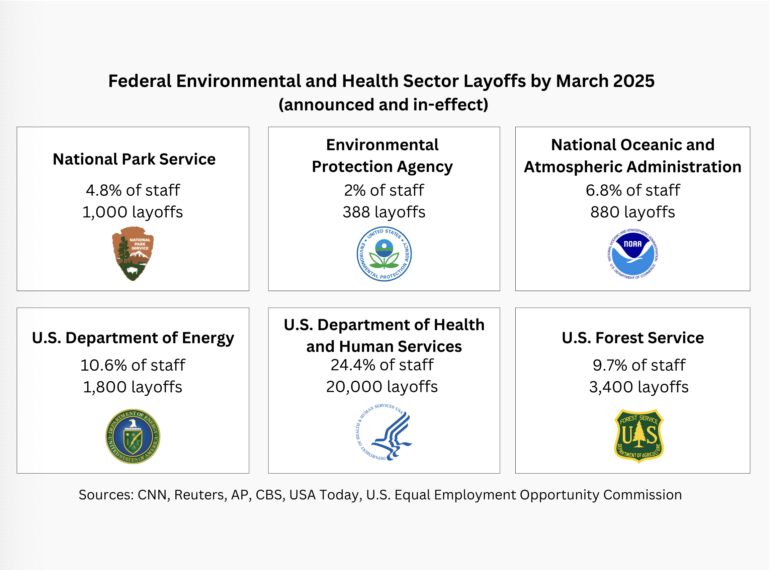
Schaefer has two environmental minors, including sustainable agriculture and food systems as well as science, technology, environment and public policy.
Her other dream pathway would be to go straight into a doctoral program for either political ecology or environmental sociology after graduation. When she sought advice about pursuing graduate school with a James Madison College administrator, she was met with concerns about competition with federal employees who have been laid off and funding for graduate programs themselves.
Dr. David Rothstein, a professor at the Department of Forestry at MSU, said there is a lot of uncertainty.
“One way or another, most graduate students at the school of MSU are funded off of external grants,” said Rothstein. “Federal grants are a huge source of those.”
While federal grants can directly fund student financial packages, Rothstein said these grants also fund research projects. Students working on these research projects receive a portion of the grant as compensation. Rothstein said he knows of two grants within the Department of Forestry that were frozen.
“Government at the federal level, at least, isn’t going to back you… that’s just how much more important grassroots efforts and community engagement is,” Miles said.
Her work on community engagement projects with ESSU and as an intern with the Veggie Box Community Supported Agriculture program at the Allen Neighborhood Center has helped reinvigorate her purpose, she said.
While Schaefer said she feels dreadful, she thinks the best thing to do right now is to protest and join an organizing group. She said the MSU Sunrise Movement is currently advocating for a green energy transition and a divestment from fossil fuels through a Green New Deal at MSU.
“That’s where you meet like-minded people who are just as fed up with the situation as you are and oftentimes are also… incredibly hopeful, optimistic, creative people who, like, want to make a change and have the resources and the means to do so,” Schaefer said. “It is really hard to imagine… what a better world could look like when our current one is just not sufficient.”
