
The Greater Lansing Food Bank: The community impact of food assistance for Michigan’s students
By Mia Litzenberg, Jacob Maurer, Gavin Hutchings and Kaitlyn Delaney | Spartan Newsroom
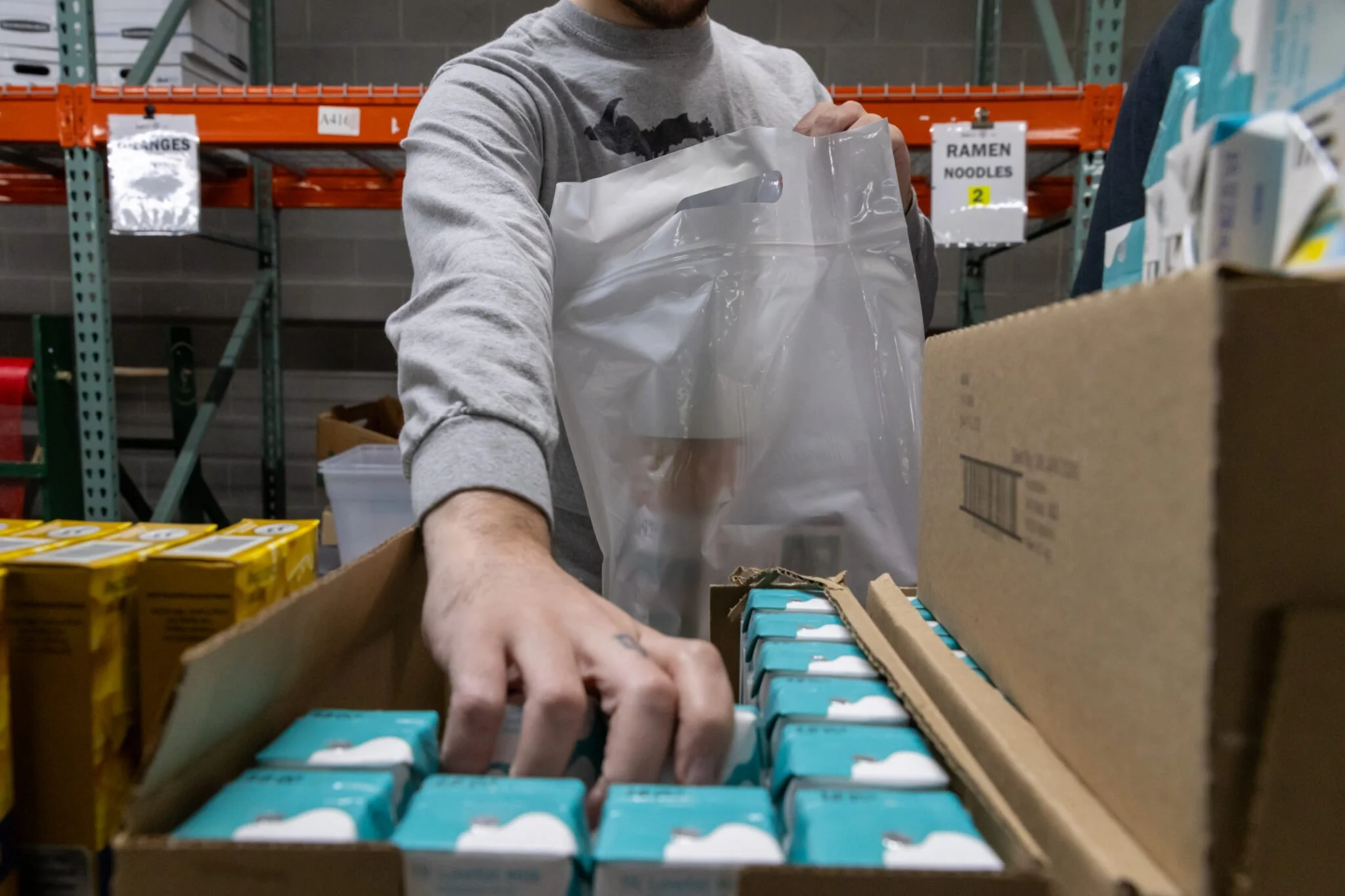
A Greater Lansing Food Bank (GLFB) volunteer packs a bag with shelf stable milk for the Weekend Survival Kit (WSK) Backpack Program in Lansing, Mich., on April 8. The GLFB welcomes volunteers to help with the sorting and organization of donations. Photo by Gavin Hutchings
To Katlyn Cardoso, child hunger in Michigan is not an abstract issue – it is a devastating obstacle for students and a driver for solutions in her own backyard.
Cardoso is the senior manager of marketing and communications at the Greater Lansing Food Bank. (GLFB). The food bank serves seven counties, where one in six children are food insecure. This is the equivalent of 22,298 children in school who experience the added challenges that come with food insecurity.
Inadequate access to nutrition is linked to adverse effects on social, emotional, and behavioral development. It also hinders a child’s ability to learn and achieve academic success.
The food bank is tackling this problem with their Weekend Survival Kit (WSK) Backpack Program. While many schools offer free meals during the school day through the state-funded Michigan School Meals Program, accessibility is often limited to school hours. The WSK Backpack Program provides portable food kits to students over weekends when school is not in session. The program currently serves 187 schools across 51 school districts.
“The driving force between having a program like that is just the reality of the scale of childhood hunger in our communities and the detrimental effects that that has on child development,” Cardoso said. “If a child is food insecure, it means that they can be more likely to exhibit signs of poor academic performance, increased health problems, developmental differences.”
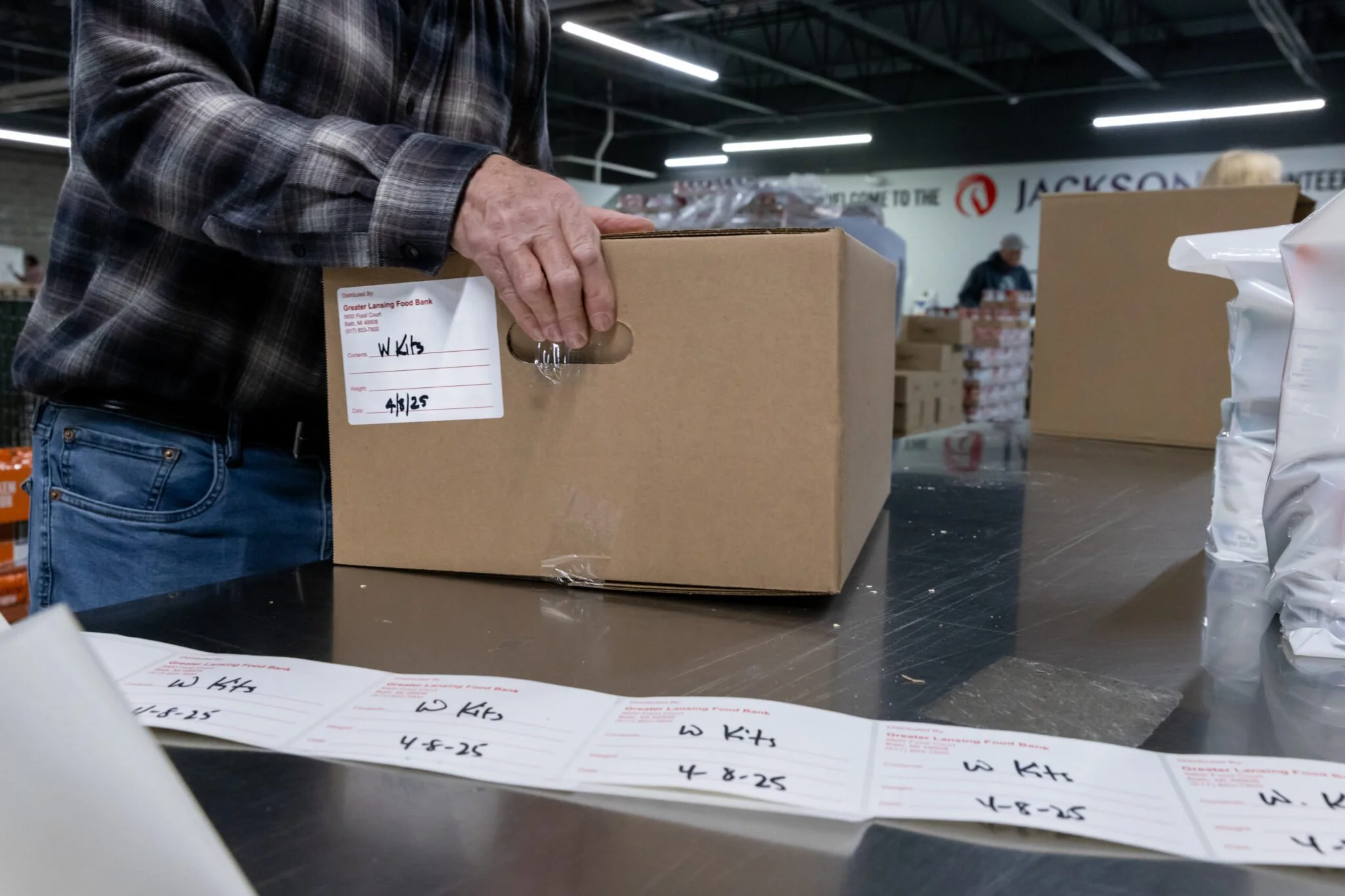
A Greater Lansing Food Bank volunteer seals and moves a weekend kit box onto a palette in Lansing, Mich., on April 8, 2025. Weekend kits are free and provide food to get children and families through the weekend. Photo by Gavin Hutchings
The goal of the WSK Backpack Program is to help alleviate some of that strain. When looking at measures of success, Cardoso said there are two major indicators. One is that the food bank can meet the needs of a significant portion of food-insecure children in the area it serves. The other is that the number of food insecure children goes down.
“The food bank doesn’t focus on ‘the needy’ or ‘the hungry.’ They’re our neighbors, and we know them,” said GLFB marketing communications specialist Leah Wright.
The Greater Lansing Food Bank partners extensively with the Michigan Department of Education to ensure that the WSK Backpack Program also meets state nutrition requirements.
Michigan Department of Education guidelines require school nutrition programs to include more than one kind of milk, fruits and vegetables, meat or meat alternatives, and grains in quantities approved by the U.S. Department of Agriculture by school grade level.
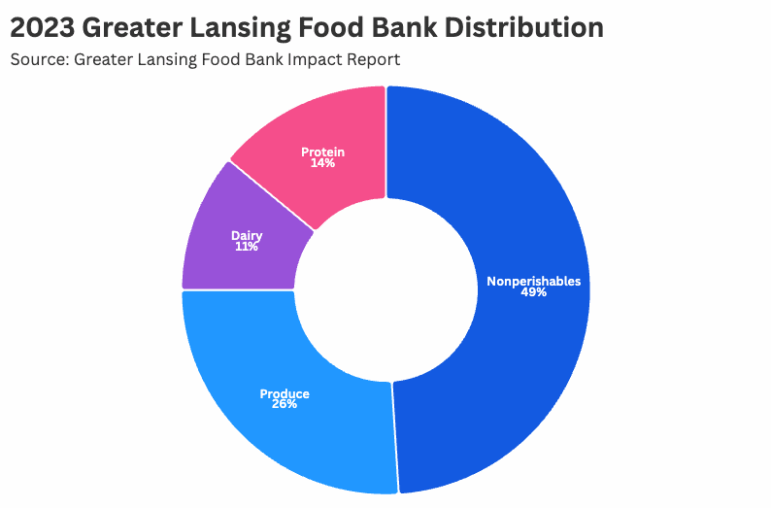
Graphic by Jacob Maurer
Fruits and vegetables can both be canned, fresh, frozen or in juice form, but vegetables must also meet certain subgroups. Those sub-groups include dark green, red or orange, starchy, beans and peas (legumes), and others.
Grains must follow the 80/20 rule. This means that 80% of the serving per week should be whole-grain rich, whereas the remaining 20% can be enriched grain servings.
The food bank is also making efforts to better gauge not just what students need, but what they want, through partnerships with the local library system, school districts, individual schools, teachers and administrators. One of the strategies the food bank has used to boost engagement with the program is increasing the variety of food options available to students.
“A student who’s enrolled in the Weekend Kits program has as much access to variety as if they were just going to the grocery store to pick things week after week,” Cardoso said.
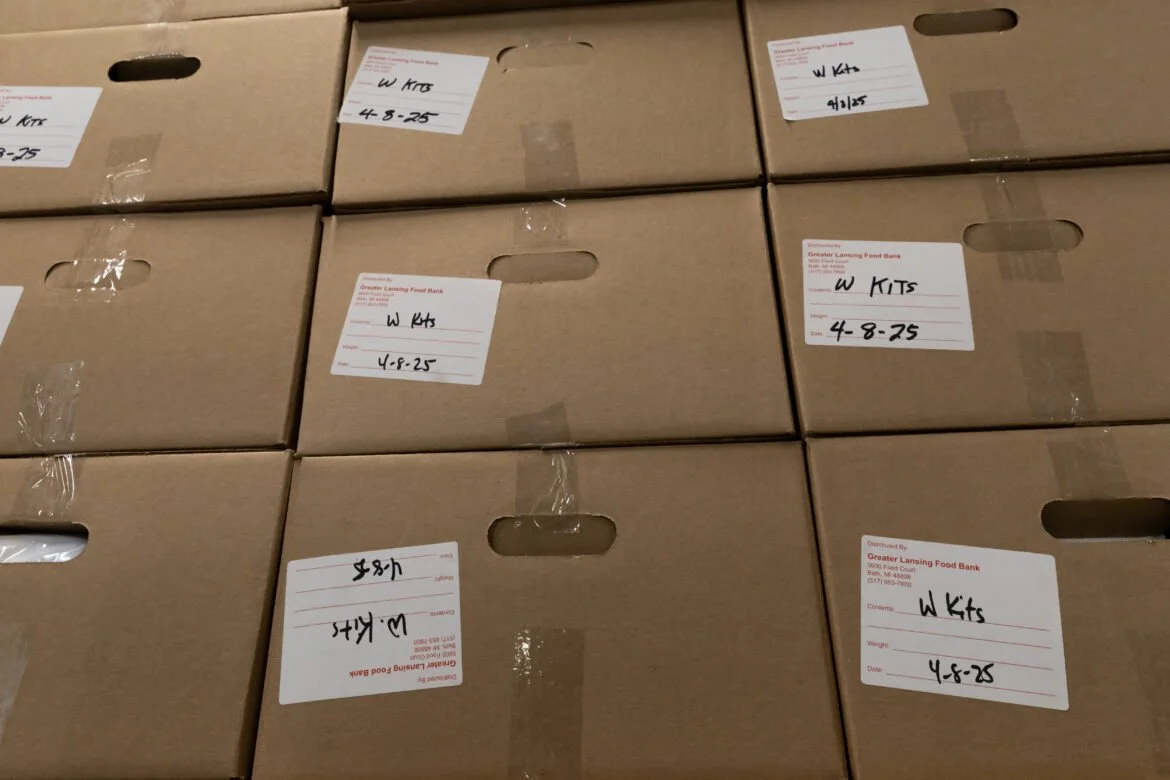
Weekend kit boxes ready to be distributed at the Greater Lansing Food Bank (GLFB) in Lansing, Mich., on April 8, 2025. Weekend kits are packed with a variety of fresh and shelf stable foods. Photo by Gavin Hutchings
The food bank is also in the process of expanding culturally familiar kits to work towards equitable access to options and be more inclusive with the foods that are offered.
Dr. Katherine Alaimo, an associate professor in the Department of Food Science and Human Nutrition at Michigan State University, centers her research on food insecurity and school nutrition.
“We’ve actually found that with our research as well, that if you offer choice… first of all, your kids are gonna be more likely to like one of the items,” Alaimo said. “But also, there’s something psychological about making a choice… that makes the kids more likely to eat it.”
Another engagement strategy is creating a sense of family participation in the preparation of the meals provided through the program.
“Having that component where it’s not just ensuring that they have the food but also bringing them into and participating around meal preparation and having that be something that’s joyful and an opportunity for family connection is really important,” Cardoso said.
The free meals offered to children also incentivize engagement with parents who may not be able to afford to keep themselves nourished.
“When you’re looking at children in food-insecure households, sometimes it’s not that the child isn’t receiving food. It’s that the parents are having to make the decision between them having enough to eat and their child eating. And most of the time, a parent is going to choose making sure that their kid has food,” Cardoso said. “So another really important impact of this program is making sure that parents and caregivers also are able to stretch their dollar a little bit further to make sure that everyone in the household is able to eat.”
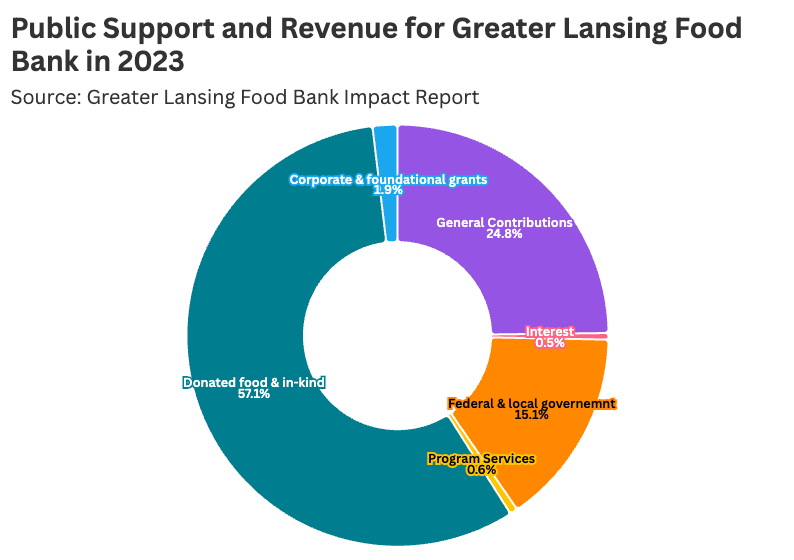
What the food bank pours into the community, the community pours back into the food bank. While it receives funding from federal and state grants, corporate sponsors, and foundations, the largest portion of its revenue comes from individual donors.
“We have a pretty good, diverse array of where our funding comes from,” Cardoso said. “When you don’t have all your eggs in one funding basket, you’re more resilient.”
Graphic by Jacob Maurer
The work that goes into creating food security through initiatives like the WSK Backpack Program is also made possible by volunteers.
“We could not do what we do without our network of volunteers,” Wright said. “We have a very dedicated base of volunteers.”
The food bank addresses one more hidden barrier – the stigma associated with seeking food assistance.
“One of the biggest barriers … is the stigma and shame that you often face with receiving help, especially when it comes to food and nutrition security,” Cardoso said.
“That can be a huge source of anxiety and shame to receive the help that you need.”
Just because food is available doesn’t mean every child feels comfortable taking it. Making the program inclusive to all students by completing a single form, regardless of income, is how the food bank is breaking down that barrier.
In a perfect world, Cardoso said she would love for the food bank to not have to exist because every child had access to meals.
“When children have enough to eat, they can realize their full potential,” Cardoso said. “They can focus on completing their schoolwork, they can focus on extracurriculars, moving toward graduation, just playing and having fun with their friends [and] building community.”
